


William Thomas McKinley Collection • MS 104
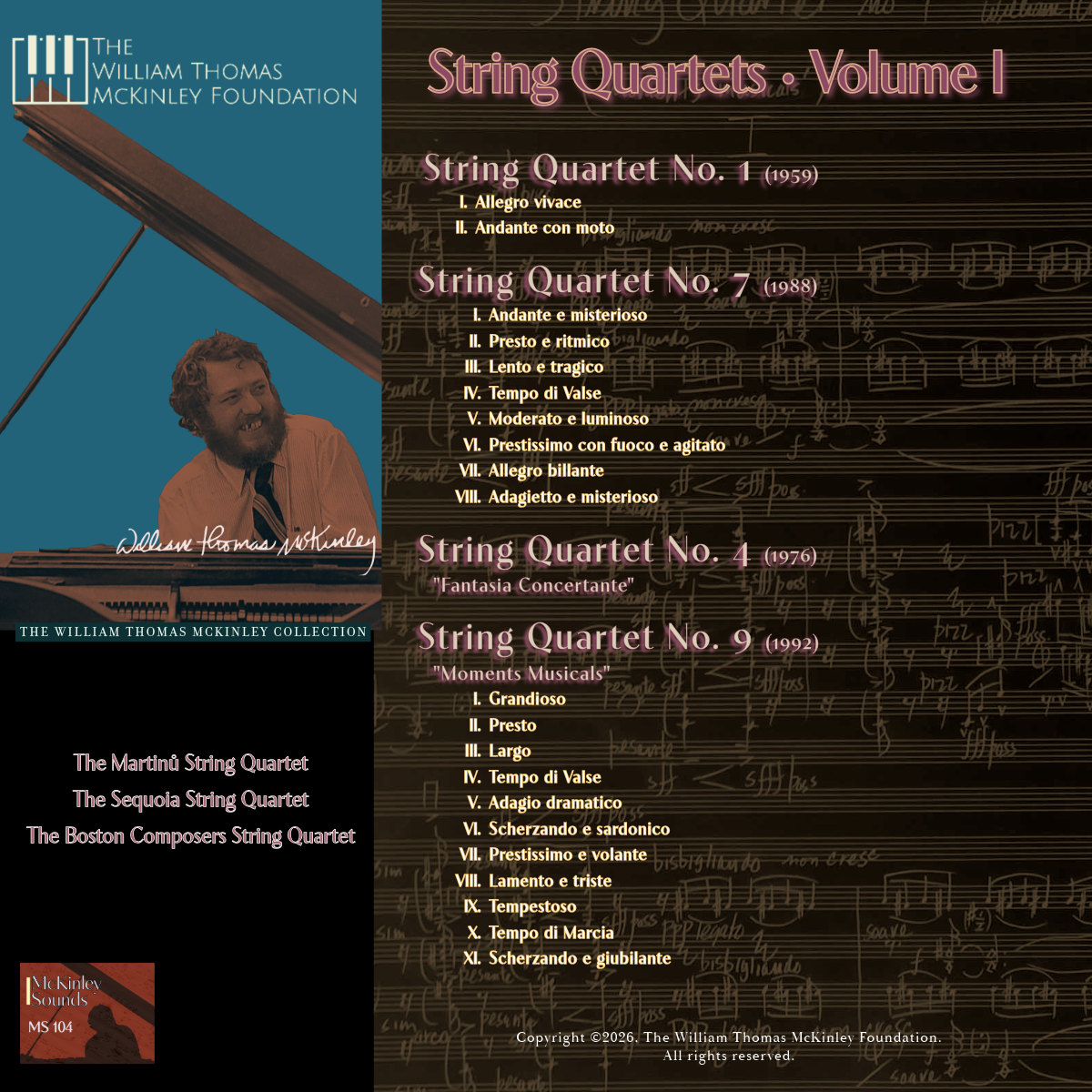
String Quartets • Volume I
This volume of string quartets showcases music that is both forward-looking and yet timeless. The evocative collection highlights the many different moods and characters of McKinley’s brilliant writing, traversing four different stylistic periods of the composer’s artistic life. Both historic and new recordings by contemporary music’s leading string quartets are featured here in this compelling new album.
Also available through these outlets:


Personnel & Biographies
Martinů String Quartet
Lubomír Havlák, violin
Adéla Štajnochrová, violin
Martin Stupka, viola
Jitka Vlašanková, violoncello
The Martinů Quartet is one of the most important representatives of the Czech quartet school. At its beginning, it was pedagogically formed by members of the Vlach and Smetana quartets, Viktor Moučka and Antonín Kohout. Among their other teachers were personalities of the world quartet tradition - members of the Quarneri, Tel Aviv, Juilliard and Amadeus quartets. The quartet (then still known as the Havlák Quartet) soon won a number of laureate titles at prestigious international competitions. The most significant include awards from the Yehudi Menuhin competition in Portsmouth, the ARD in Munich, Evian, and the Prague Spring. The Martinů Quartet followed up these successes with awards for CD recordings of Czech composers. The compilation recording of seven string quartets by Bohuslav Martinů won the MIDEM prize in Cannes, and the recording of Leoš Janáček's String Quartets and Sylvia Bodorová's Terezín Ghetto Requiem won the prize of the British music portal MusicWeb International. Currently, music critics (Gramophone, BBC Music Magazine, Classica, Harmonie) have highly praised the double album with quintets by Sergei Tanějev (Supraphon 2015) and the recording of chamber music by Petr Eben (Supraphon 2017). The music monthly Harmonie wrote: "The Martinů Quartet belongs not only to the Czech but also the world elite and plays with incredible enthusiasm and virtuosity...", the French magazine CLASSICA assessed the quartet as follows: "The Martinů Quartet has a generous gesture... The two string quintets reveal the wealth of inspiration and freshness that the performers convey in their modern presentation with unrivaled elegance." During its rich musical career, the Martinů Quartet has performed on prestigious concert stages in Europe, North America and Japan and has collaborated with radio stations such as the BBC, Radio France, ARD, ORF and Czech Radio. Particularly revealing was, for example, their recording of three String Quartets by František Škroup (released by Radioservis) or the recording of the Oboe Quartet by the leading modern American composer Elliott Carter. The latest recordings for the Czech Republic include the Sonata for Viola and String Quartet by Luboš Fišer with violist Jitka Hosprova.
Sequoia String Quartet
Yoko Matsuda, violin
Miwako Watanabe, violin
James Dunham, viola
Robert Martin, violoncello
Founded at the California Institute of the Arts in 1972, the Sequoia String Quartet established itself as one of America’s notable chamber ensembles through a combination of rigorous musicianship, adventurous programming, and a deep commitment to contemporary music. While Quartet-in-Residence at CalArts, the group won First Prize in the 1976 Walter W. Naumburg Chamber Music Award, which led to a high-profile New York debut at Alice Tully Hall in 1977. That concert included the world premiere of McKinley’s Fantasia Concertante heard on this recording. Through the 1970s and into the mid-1980s, the Sequoia toured widely and made recordings spanning standard repertoire and modern works; personnel evolved over time, with significant changes announced in 1985. The quartet also championed new works, notably Paul Chihara’s Concerto for String Quartet and Orchestra—a project initiated in 1980 with Seiji Ozawa and later premiered in Tokyo in 1985 by Ozawa, the Sequoia, and the New Japan Philharmonic. Beyond the recording here, others include a Delos release pairing Ravel’s String Quartet with Bartók’s Quartet No. 3, as well as a contemporary-program disc issued by Music & Arts.
Boston Composers String Quartet
Clayton Hoener, violin
Mark Beaulieu, violin
Scott Woolweaver, viola
Andrew Mark, violoncello
The Boston Composers String Quartet (BCSQ) emerged in 1985 as a Boston-based ensemble devoted to giving freshly written music the same polish and advocacy reserved for the classical canon. Praised for its “sonorous, keen and persuasive” playing, the quartet drew attention through debut recitals in Boston and New York (1988) and a steady stream of works composed for—and dedicated to—the group. In 1993 BCSQ won the Silver Medal at the first Osaka International Chamber Music Competition and Festa, performing Beethoven and Bartók alongside Akira Miyoshi’s String Quartet No. 3, written for the event. That same year the quartet became the first Artists-in-Residence at the All Newton Music School (West Newton, Massachusetts), building an education initiative—Historical Journey through Music of the String Quartet—that combined in-school visits, open rehearsals, lecture-demonstrations, and radio broadcasts. Supported by a Chamber Music America three-year residency grant and honored with the 1995 CMA/ASCAP Award for Adventurous Programming, BCSQ documented American music on disc, including Daniel Pinkham’s String Quartet No. 1 and the complete string quartets of Leon Kirchner, recorded with the composer’s participation. Across concerts, classrooms, and recordings, BCSQ helped define a New England model for contemporary chamber music: distinctively historically informed, community minded, and fearlessly new.
Liner Notes
String Quartet No. 1 (1959)
String Quartet No. 1 (1959) falls under the McKinley’s First Early Period. Performed ably here by the Martinů Quartet, it is dedicated to Nikolai Lopatnikoff, McKinley’s early mentor and composition teacher at then-Carnegie Tech (now Carnegie Mellon). Lopatnikoff was a student of Prokofiev and one of McKinley’s early influences. The composer was 20 years old at the time of the composition of String Quartet No. 1, and yet the piece is fully formed and already mature. The piece is divided into two movements which are highly contrasting on the surface, but which deploy subtle connectives that tie the two together. The common linkages between the two movements include an interest in angular melodic lines, chromatically inflected intervals, imitative counterpoint, and tripartite textures (often one emergent line, one accompanying line, and a third aspect in dialogue with each). The harmonies are steeped in a healthy amount of dissonance in both movements, though one is never too far afield from tonal centers and other pitch structures that ground the piece. The rhythms are strongly motoric in both movements, despite the disparate tempi that characterize each.
That both movements employ imitative counterpoint presages a lifelong interest in maintaining a dialogue with older forms of music throughout the composer’s career. This raises the question: what is neoclassical about this piece? One certainly couldn’t confuse it with Mozart (or even a Stravinskian sort of Pergolesi). As mentioned, imitative counterpoint abounds; furthermore, textures clearly bifurcate (and sometimes trifurcate) into hierarchical strata so one perceives “main melody plus accompanimental figures” throughout. Still, these are dispersed with an egalitarian sensibility among the four members of the quartet. Ostinati frequently underpin particularly motoric and driven textures. Sharp dynamic contrasts (especially in the first movement) recall the Sturm und Drang of classicism.
All told, these elements add up to a remarkably mature early work. McKinley could have stopped here and developed this aesthetic for the rest of his life, and there probably would have been little complaint. The composer, of course, had other ideas.
String Quartet No. 7 (1988)
String Quartet No. 7 (1988) hails from McKinley’s First Middle Period. According to the composer, “each movement depicts a specific character or dramatic persona” (from the December 1988 program notes). Originally dedicated to the Alexander String Quartet, the piece is performed here by the Martinů Quartet. The piece is divided into eight movements. Each movement contributes to a veritable panoply of aesthetic directions in the mind of the composer at this point in time. Although there is great variety to be heard, McKinley insisted that there was an indivisible through-line connecting the eight movements such that “none of the eight movements can be deleted or shuffled” (1988 program note).
The first movement, marked Andante e misterioso, features a steady and quiet undulation in the cello while the other three instruments play trichords. The mysterious quality is supported by the harmonic content, which sounds ghostly and moody. A number of tempo fluctuations keep the undulation animated, drawing the listener closer in. The second movement is marked Presto ritmico and is a striking contrast to the first movement. Where the first movement was slow, quiet, and moody, the second movement is louder, much faster, and rhythmically accentuated. The movement is built on quickly repeated notes in the cello with harmonic commentary by the other three voices. Texturally, both the first and second movements have this in common: an activated cello commented upon by a harmonic accompaniment provided by the other three instruments. Where the second movement is extremely pulse-based, the third movement is extremely lyrical. It is marked Lento e tragico and is very slow indeed. The harmonic language, pitting ever-so-mild dissonances against major and minor triads, befits the tragic sensibility of the movement exceedingly well. The movement is pensive and quiet and ends more with a question mark than with an exclamation point.
The fourth movement is “just what it says on the tin”: Tempo di Valse, in this case. McKinley’s all-pizzicato waltz is at times witty and sardonic, sometimes wry, and sometimes counterintuitively lyrical, as melodic lines emerge in spite of the ubiquitous plucking. Where the fourth movement is entirely comprised of pizzicati, the fifth movement (Moderato e luminoso) is constituted entirely of double-stop harmonics. This gives the texture a clear and ethereal quality. The rocking rhythm of the harmonics also gives the piece a bell-like sonority. Sharp dynamic contrasts lend form to this otherwise textural movement. The sixth movement is, like the second, pulse-based and, like the fifth, focused on texture. In this case, repeated eighth notes motorically push forward, outlining mildly to moderately dissonant harmonies.
The seventh movement—Allegro con fuoco e brillante—asks for virtuosity from the entire quartet, but particularly the first violin, which opens with a solo comprised of alternating bowed notes and left-hand pizzicati. This is followed by a cello solo in higher registers pitted against a triplet pulse in the other three instruments (texturally reminiscent of previous movements once again). The left-hand pizzicato idea returns in the first violin but is abruptly supplanted by a quintuplet pulse idea in all four instruments, heading furiously to a conclusion. Finally, the eighth movement is marked Adagietto e misterioso. The mysterious sensibility is achieved with sextuplet tremolo figures in all four instruments, with mutes on and played sul tasto (i.e., bowed on the fingerboard). The aggregate harmonies shift continuously until a grand pause, where the mutes come off, and then the quiet tremolos are replaced with loud tremolo figures. A climax is reached, and beyond that, the tremolo figures reassert themselves, gradually diminishing in dynamic and moving forward to the conclusive, punctuating final harmony.
Each movement entails a distinct character, just as the composer maintains, but there is also a through-line of focus on harmony, texture, and virtuosity, with deeply lyrical excursions also to be found.
String Quartet No. 4 (1977) “Fantasia Concertante”
McKinley’s 1977 Fantasia Concertante, also known as String Quartet No. 4, is from his Second Early Period and is a fully, unapologetically modernist work that knocks on the door of new complexity. Its single movement is dense, deeply chromatic, and brilliantly textural—and yet remains remarkably accessible. Commissioned by the Sequoia Quartet (whose recording appears here) and the Naumburg Foundation in 1976, it is both a product of its time and also speaks to some timeless musical truths. Among them, form: the piece is a rondo in which the opening material returns on four different occasions, according to the composer, who likens the form to Jeux by Debussy. A deep interest in coloristic content also characterizes the work. In a March 1977 program note, McKinley cites Bartók in particular as influencing his coloristic palette, though there is no conscious quotation of Bartók. Finally, the intensity and forward motion of contemporary jazz are also at work, according to the composer. Although McKinley is quite upfront about his influences, he also rejects the idea of eclecticism or collage—stylistic proclivities that were very much in vogue in the mid-1970s United States landscape. Instead, the piece places these various influences within a “controlled structural framework” (McKinley’s phrase).
The title refers to two concepts as well: Fantasia means continuous evolution of materials, while Concertante refers to the virtuosity asked of all four members of the quartet. Drama is also at a premium in this work: McKinley uses the words “violence,” “wildness,” and “explosion” to juxtapose “introspection,” “prayer,” and “spiritual meditation” (again in his 1977 program note). The drama between these two conflicting states is very much self-evident in the composition and in the performance. The virtuosity on display by the Sequoia Quartet in the performance here is also riveting and compelling, adding to the overall accessibility of the otherwise thorny and dissonant harmonic language. All in all, McKinley’s rondo takes us on a colorful journey: sometimes the ride is bumpy, sometimes the ride is smooth, but the journey is always its own reward.
String Quartet No. 9 (1977) “Moments Musicals”
String Quartet No. 9 (1992), subtitled “moments musicals”, comes from the composer’s Second Middle Period, which concerned itself with the incorporation of jazz and abstract harmony into a coherent, mature whole. It is dedicated “to my friend James Dunham and the Cleveland Quartet” and is represented here by the Boston Composers String Quartet.
The piece is divided into eleven short movements, each movement taking on a distinct character. The first movement (Grandioso) presents a dichotomy between two dense chords and undulations that emanate from the harmonic implications of those two chords. The character is nearly post-minimalist in nature, which was definitely a sound in the air in 1992. The second movement, marked Presto, is furious and heavily pulse-driven, presenting a texture of repeated double stops in each instrument that outlines dense harmonies. The third movement, marked Largo, is deeply lyrical in nature, supported by harmonies that are mildly dissonant and thorny, but always support the sensibility of the lyrical lines. Toward the middle, harmonics punch through the texture, lending it a ghostly sensibility.
The fourth movement, Tempo di Valse, is brightly upbeat in three. However, the metric sensibility is sometimes challenged by a hemiola in the cello, which makes the music temporarily sound ambiguously in 2 rather than in 3. The fifth movement is marked Adagio e dramatico. It involves a juxtaposition of dense harmonies built out of double stops in each instrument and lyrical asides in octaves among the four instruments. At no point is any instrument left out of this movement, lending the texture a particular density. “Scherzando e sardonico” marks the sixth movement, which opens with a pizzicato texture among the four instruments. Toward the middle, the sardonic pizzicati really start to dance, thanks to a persistent three-note ostinato in the cello. The movement ends with strumming-like figures of conclusive force.
The seventh movement, Prestissimo e volante, opens with a whirlwind of sound in which the texture is built out of very rapidly repeating three-note sets. This gives way to a rhythmic figure marked “sarcasmo e mart. sempre,” which persists beneath dissonant harmonic material until the three-note whirlwind idea returns, pushing the movement toward its conclusion. The eighth movement, Lamento e triste, is exactly that: pure lyricism presented in the cello, accompanied by the other three musicians in homorhythmic commentary. The ninth movement, marked Tempestoso e sardonico, is most definitely sardonic as described. Though perhaps the most clearly tonal of any of the movements, there is a beguiling twisting among local-level tonal centers that always leaves one guessing as to what’s coming next. Movement ten, Tempo di marcia, is underpinned by a rhythmic pattern in the cello that gives the movement its march-like character. Against the cello, the other three instruments assert challenging harmonies expressed in longer tones. There is also an emphasis on color in this movement, as the instruments exchange between ordinario and sul ponticello (an eerie-sounding technique in which the player bows near the bridge of the instrument).
Last but certainly not least is the eleventh and final movement, marked Scherzando e giubilante. It is in the unusual meter of 9/4, and is also very rapid and pulse-based, asserting very quick quarter-note values throughout. The labyrinthine paths taken by the harmonies are ruled by strict and logical voice-leading principles.
In total, the aggregate effect of these cumulative character pieces is to convince one of the composer’s tremendous musical vocabulary and command. Although each movement is quite short (usually under 1:30 in length), each nevertheless packs the proverbial punch. The year 1992 saw McKinley at the height of his maturity and powers, and yet with two more significant periods (First and Second Late Period) still to come.
–Robert Gross, June 2025
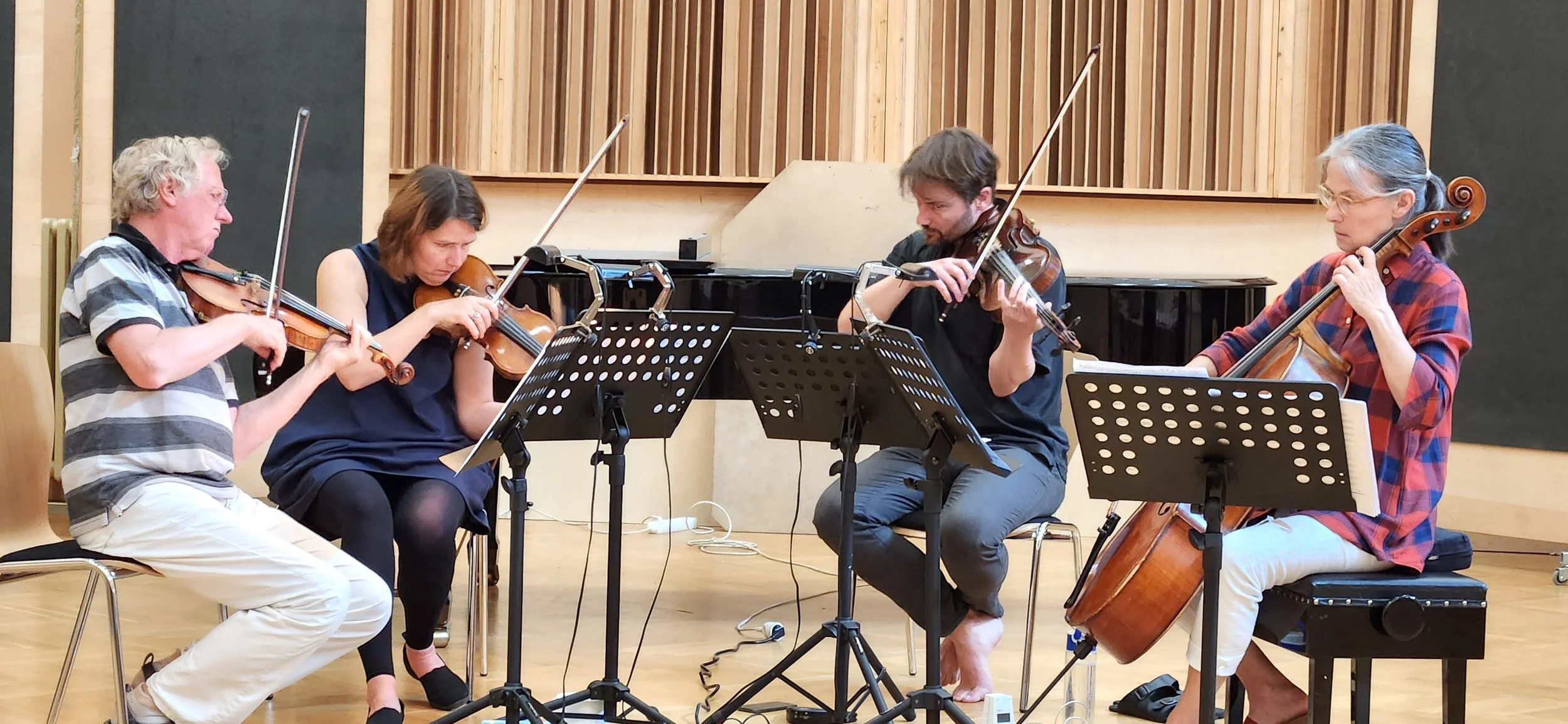
The Martinů Quartet recording at Studio Martinek, Prague, June 2023.
Album and Recording Credits
String Quartet No. 1 and No, 7 [Martinů Quartet]
Recorded June 2023 at Studio Martinek (Prague, Czech Republic)
Recording Engineer: Jan Licžař
Recording Producer/Editor: Milan Pulický
String Quartet No. 4 [Sequoia Quartet]
Recorded September 1977 at United-Western Studios (Hollywood, CA)
Recording Engineer: Jerry Barnes
Recording Producer / Editor: David Cloud
String Quartet No. 9 [Boston Composers String Quartet]
Recorded November 1996 at First Congressional Church (Harvard, MA)
Recording Engineer: Jonathan Wyner
Recording Producer: Elliott Miles McKinley
Mastering Engineer: John Weston at Futura Productions (Roslindale, MA)
Executive Producer: Elliott Miles McKinley
Album Design: Elliott Miles McKinley
Liner Notes: Robert Gross
Robert Gross is a composer, music theorist and music therapist. He received his DMA in music composition at University of Southern California where he also received a graduate certificate in Scoring for Motion Pictures and Television. He also received an MA in Music for Film, Television and Theatre from the University of Bristol; an MM in Music Composition from Rice University; and a BM in Music Composition from Oberlin Conservatory. Composition awards and honors include winner of the Arch Composition Award for Concerto for Piano and Wind Instruments; Winner, tri-annual Inter-American Music Awards Composition Competition for Sonata for Solo Unaccompanied Violin. He has presented papers at the national Society for Music Theory conference, the Texas Society for Music Theory Conference, the West Coast Conference of Music Theory and Analysis, and Society of Composers, Inc. Music theory publications include Perspectives of New Music. He is a Board Certified Music Therapist.
Obtain the sheet music
String Quartet No. 1 (1959)
String Quartet No. 7 (1988)
please contact us for the following works:
String Quartet No. 4 (1976)
String Quartet No. 9 (1992)